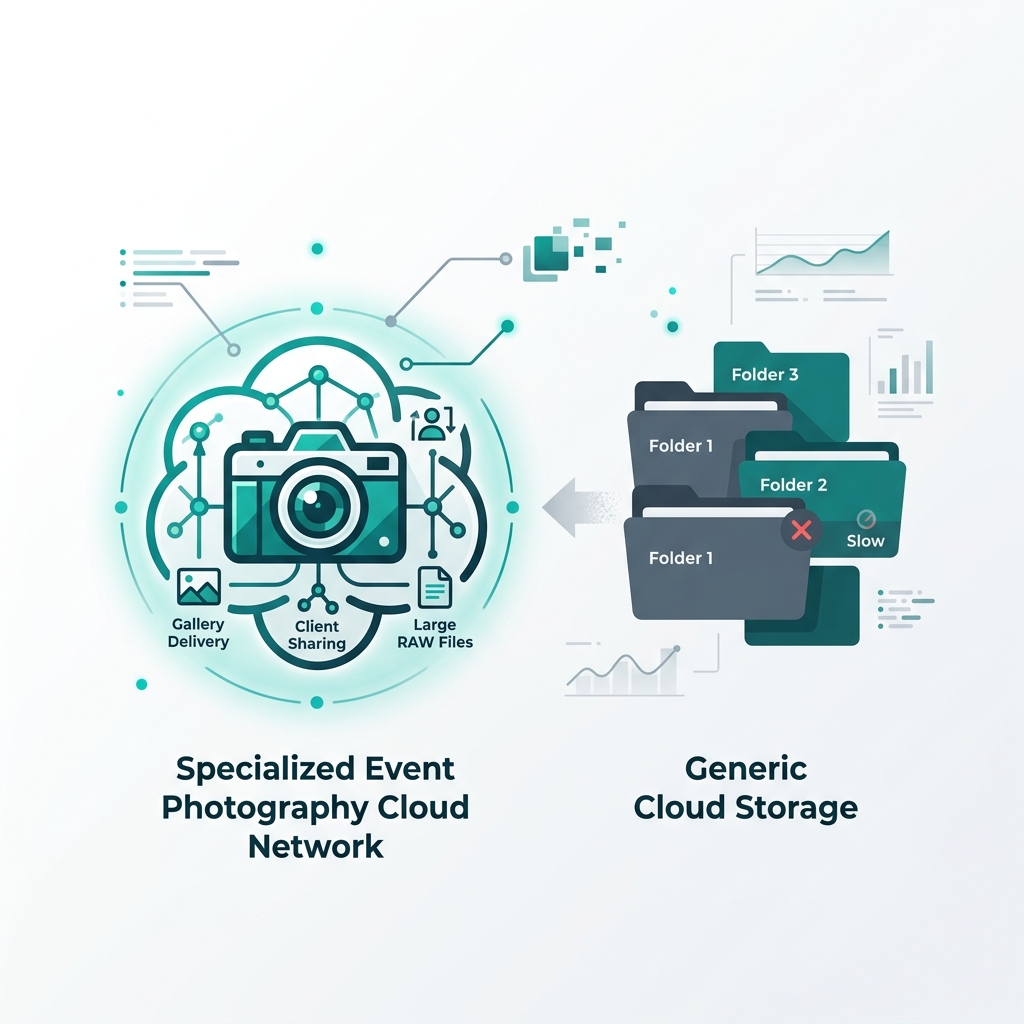
For the last twenty years, the fundamental architecture of photo distribution has remained stagnant. It was entirely based on the concept of the "Folder." A photographer captures 5,000 photos, dumps them into a digital bucket, and hands the bucket to the client. The client, and their guests, are then forced to manually dig through that bucket to find the specific images relevant to them.
This model worked when a gallery contained 50 photos. In the modern era, where a three-day Indian wedding or a massive corporate tech summit yields upwards of 8,000 high-resolution images, the "Folder" model completely collapses under its own weight.
To solve the distribution bottleneck of massive datasets, the photography industry is undergoing a violent major shift. We are abandoning the manual search entirely and embracing enterprise-grade machine learning. Specifically, we are deploying Biometric Facial Recognition powered by complex Vector Databases.
This deeply technical masterclass will strip away the "magic" of AI and explain the exact mathematics and cloud architecture powering platforms like Ayojan. We will deconstruct how a 2D photograph is translated into a 512-dimension mathematical vector, how HNSW algorithms search massive datasets in sub-50 milliseconds, and why this technology is mathematically necessary for the future of the event photography industry.
I remember sitting in the studio at 2 AM, staring at thousands of unsorted photos. That's when I realized the old way of doing things was completely broken.
The Core Problem
AI facial recognition is not a gimmick; it is an enterprise-grade infrastructural necessity for high-volume data distribution.
- The Death of the Folder: Why human attention spans cannot survive scrolling through 8,000 thumbnails, and how the friction destroys brand value.
- The Vector Translation (The Math): How convolutional neural networks (CNNs) analyze a face and convert it into a 512-dimension mathematical string, ignoring lighting and angles.
- The HNSW Search Algorithm: Why traditional database searches (O(N)) crash under massive photo loads, and how HNSW graphs achieve lightning-fast O(log N) retrieval.
- The Privacy Firewall: Why biometric data is basically more secure than public URLs, and how vector siloing protects high-net-worth individuals from leaks.
(Also, you might find our insights on this topic useful).
The Death of the Folder (The UX Crisis)
Before examining the solution, we must mathematically define the problem.
Assume you are shooting a massive, 1,000-person corporate summit over three days. You deliver a final gallery of 6,000 images. You deliver this gallery via a standard Google Drive or Pixieset link.
An attendee, John, wants to find the photo of himself speaking on a panel on Day 2. If the gallery displays 20 thumbnails per page, John must click "Next Page" 300 times to view the entire gallery. If he spends 2 seconds scanning each page, it will take him 10 solid minutes of highly focused, frustrating administrative labor just to look at the thumbnails.
The Abandonment Metric
Modern consumers have been conditioned by TikTok and Instagram algorithms to expect instantaneous, hyper-personalized data delivery. They do not have the patience to scroll for 10 minutes.
When faced with a 6,000-image folder, the abandonment rate is catastrophic. Nearly 70% of guests will scroll through the first 50 photos, get bored, close the browser, and never look at the gallery again.
You captured incredible photos of John on the panel. John wanted to buy a print of that photo and post it to LinkedIn, tagging your studio. But because the delivery architecture was archaic, the connection was never made. The value was created, but it was lost in the friction of the "Folder."
The Vector Translation (The Mathematics of a Face)
To bypass the manual scroll, we must teach a machine how to "see" a face. This is achieved through Convolutional Neural Networks (CNNs).
When a user interacts with the Ayojan platform, they take a selfie on their phone. The platform does not simply look at the pixels in that selfie. It performs a massive mathematical translation.
The 512-Dimension Vector
The AI analyzes the geometry of the face. It measures the exact distance between the pupils. It measures the depth of the eye sockets, the width of the jawline, the contour of the cheekbones, and the structural shape of the nose.
It takes these millions of micro-measurements and processes them through the neural network, outputting a single string of numbers known as a Vector Embedding. In enterprise systems, this is typically a 512-dimension or 1024-dimension vector.
This vector is a highly complex, unique mathematical fingerprint of that specific face.
The Magic of Invariance
The true power of the Vector Embedding is its invariance to external conditions. Because the AI is measuring the underlying 3D geometry of the skull and facial features, it does not care about the superficial 2D pixels.
- Lighting: The AI recognizes the face whether the photo was taken at noon in harsh sunlight or at midnight on a dance floor illuminated by a purple strobe light.
- Angle: The AI recognizes the face whether the person is looking directly at the camera or looking away at a 45-degree profile angle.
- Aging and Accessories: The AI can successfully match a photo of an executive wearing glasses and a beard today with a reference photo of them clean-shaven five years ago.
The machine is not looking at a "picture"; it is calculating geometric geometry.
(Want to dive deeper? Check out our guide on related workflows).
The HNSW Search Algorithm (Lightning Speed)
Translating a face into a vector is only the first step. The true engineering challenge is searching the database.
When you upload 6,000 photos to Ayojan, the AI scans every single photo, detects all the faces, and generates vector embeddings for every face in the database. If there are an average of 3 faces per photo, the database now contains 18,000 mathematical vectors.
The Failure of O(N) Searching
When John takes his selfie, the system generates his vector. The system must now compare John's vector against the 18,000 vectors in the database to find the matches.
A primitive database would use a linear search (O(N) complexity). It would check John's vector against vector 1, then vector 2, then vector 3... all the way to 18,000. For a massive dataset, this linear comparison would take several seconds, or even minutes, completely destroying the instantaneous UX.
The HNSW Graph (O(log N) Complexity)
To achieve sub-50-millisecond response times, enterprise platforms like Ayojan utilize an HNSW (Hierarchical Navigable Small World) vector database.
Instead of organizing the vectors in a straight line, the HNSW algorithm organizes them into a complex, multi-layered, geometric graph. Vectors that are mathematically similar (e.g., photos of John) are clustered tightly together in this geometric space. Vectors that are entirely different (e.g., photos of a blonde woman) are pushed far away.
When John takes his selfie, the search algorithm does not check every vector. It drops John's vector into the top layer of the graph. The algorithm acts like a homing missile, instantaneously leaping across the geometric space, ignoring 99% of the irrelevant data, and instantly landing directly in the center of the cluster containing John's matching photos.
This logarithmic search architecture (O(log N)) allows the Ayojan platform to search a database of 100,000 photos in the exact same fraction of a second it takes to search a database of 100 photos. The speed is mathematically guaranteed, regardless of the scale of the event.
The Privacy Firewall (Security by Encryption)
A common objection to facial recognition technology is the fear of privacy violations. Clients often assume that biometric scanning is "creepy" or dangerous.
In reality, when deployed correctly within an enterprise architecture, biometric distribution is infinitely more secure than the traditional public URL method.
The Vulnerability of the URL
As discussed in our security masterclasses, if you send a Dropbox link containing 6,000 corporate photos, that link is entirely vulnerable to social engineering. If an intern forwards the link to a journalist, the entire corporate gallery is publicly breached.
The Biometric Black Box
When a gallery is deployed via Ayojan, the database operates as a cryptographic black box. There is no grid of thumbnails for a user to scroll through.
If a journalist manages to acquire the private portal link to the gallery, they cannot see any photos. The database requires a query (a selfie) to unlock any data. Because the journalist's face was not captured at the private corporate event, their vector embedding will not match anything in the HNSW graph. The system will simply return zero results.
The biometric requirement acts as an impenetrable firewall. You cannot view the data unless you were physically present at the event, proving your authorization via your own face.
Data Anonymity
Furthermore, the Ayojan system does not care "who" the person is. The AI does not attach a name, a social security number, or an Instagram handle to the vector embedding. To the machine, the face is merely a string of 512 numbers. The data remains entirely anonymous and mathematically siloed, fully complying with strict data privacy laws (like GDPR and CCPA) while providing absolute security for high-net-worth clients.
The Economic Implications of the Tech
Understanding the technology is interesting, but understanding the economic use it provides is how you build a $1M+ studio.
When you deploy HNSW biometric architecture, you completely change the economic model of event photography.
The Eradication of Friction
Friction is the enemy of revenue. If a guest has to scroll for 10 minutes to find their photo, they will not buy an 8x10 print. The friction of the search exhausted their dopamine.
By utilizing biometric search, you reduce the "Time to Value" from 10 minutes to 45 milliseconds. The guest scans a QR code, takes a selfie, and instantly sees their flawless photo. The dopamine hit is massive.
Because you removed the friction, the guest is now psychologically primed to execute a transaction. They are highly likely to pay $15 to download the unwatermarked digital file, or purchase a massive canvas print via the integrated 1-click checkout system.
Scaling the Unscalable
Historically, shooting a 5,000-person marathon was an administrative nightmare. Photographers attempted to solve the distribution problem by manually typing the runner's bib numbers into the metadata of the photos—a grueling, expensive, error-prone process.
With Ayojan, you simply upload the 20,000 photos from the marathon. The AI indexes 20,000 faces instantly. The runners take a selfie at the finish line and instantly buy their photos.
You have taken an unscalable, manual labor bottleneck and entirely outsourced it to high-speed cloud computing. Your revenue potential is now completely decoupled from your administrative labor.
Wrapping Up The New Baseline of Luxury
In 2010, delivering photos via a digital cloud link was considered a "luxury" upgrade from physical CDs. Today, a digital cloud folder is the bare minimum expectation.
In the modern event photography industry, the new baseline for luxury is Frictionless Personalization.
High-net-worth brides, Fortune 500 executives, and massive festival organizers no longer accept the "Folder." They expect enterprise-grade technology. They expect to interact with the media instantaneously, securely, and seamlessly.
By basically understanding and deploying biometric facial recognition and HNSW vector databases through platforms like Ayojan, you are not just adopting a cool new gadget. You are rebuilding the foundational architecture of your business. You are weaponizing machine learning to eradicate administrative friction, guarantee data security, and provide an utterly magical user experience that justifies a massive premium on your pricing. The future of photography is not in the camera; it is in the code.