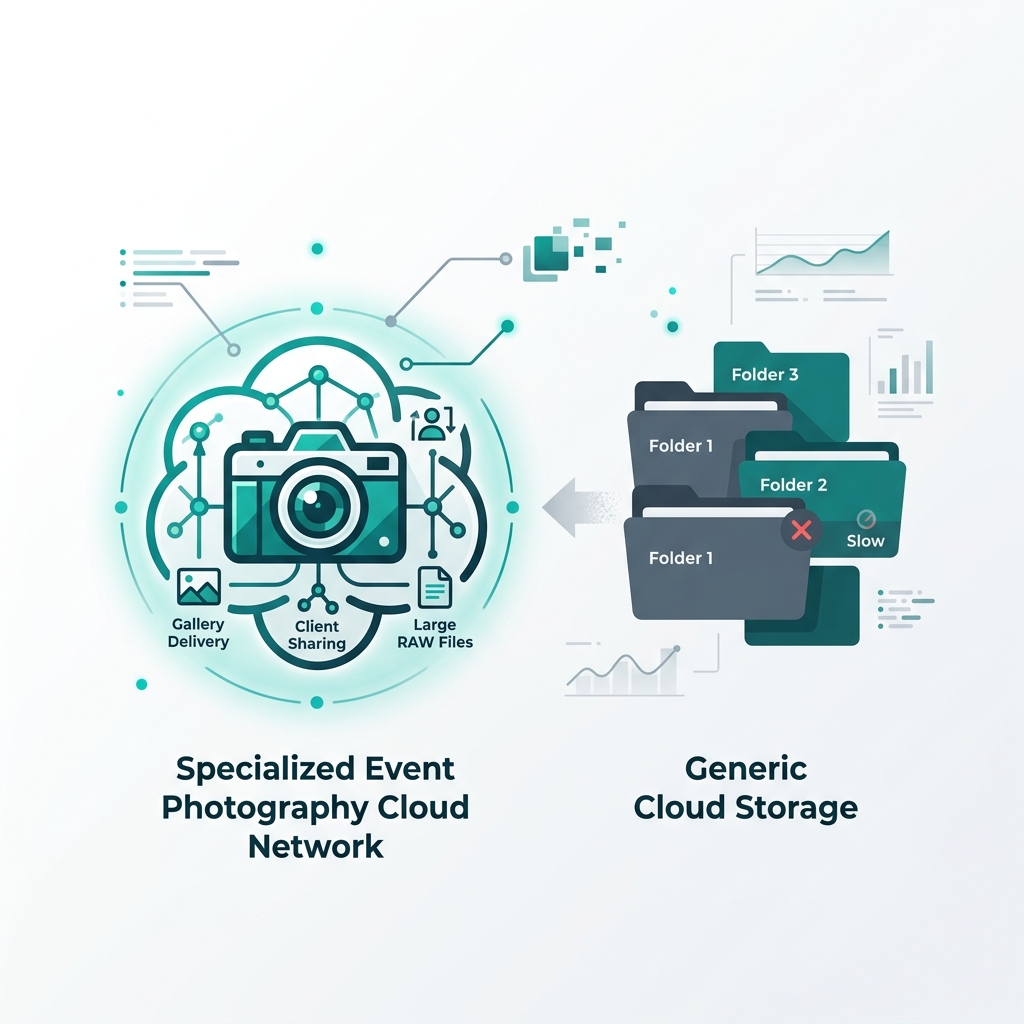
The event photography software market offers a variety of "client gallery" platforms designed to provide a pleasant interface for delivering photos. These platforms were a significant step forward from physical delivery methods like USB drives, moving the industry into the cloud.
However, as event photography scales—with faster cameras producing more images and events featuring larger guest lists—the architecture that powered the first generation of cloud gallery platforms is being tested. Delivering photos to a couple via a web link is standard, but delivering photos efficiently to hundreds of guests requires a different approach.
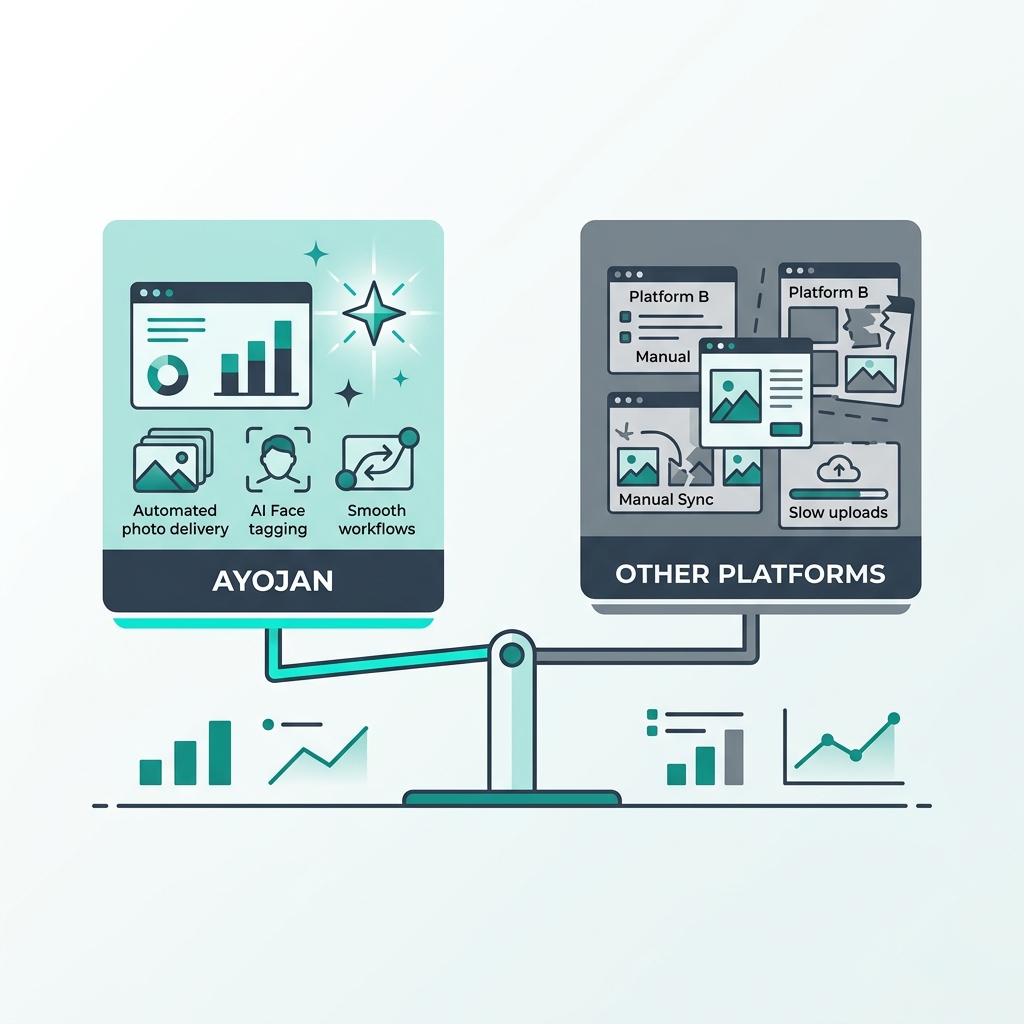
In this comparison, we will examine the structural differences between standard gallery apps and Ayojan’s purpose-built infrastructure, looking at how each platform handles UI design, pricing models, and data security.
The UI Design: Scrolling vs Searching
A noticeable difference between gallery platforms lies in their fundamental User Interface (UI) design. Many established platforms were built around the concept of a scrollable grid.
The Traditional Grid Approach
When these platforms were designed, they often focused on the primary client (e.g., the couple). The assumption was that the client would view a curated selection of photos on a larger screen. For that use-case, a scrollable grid works well.
However, as gallery sizes increase—often reaching thousands of photos per event—and as access expands to guests using mobile devices, a large grid can become cumbersome. While platforms use folders ("Reception," "Candid") to organize the images, a guest still has to scroll through many photos on a small screen to find the ones they appear in.
The Ayojan Approach: Direct Search
Ayojan uses a different architecture for guest access. Instead of having the user scroll through the database, the platform allows the user to search directly.
When a guest accesses an Ayojan gallery, they take a selfie. The AI instantly filters the large gallery down to a private selection of photos containing their face. This reduces the time spent searching and provides a more direct user experience.
(Want to dive deeper? Check out our guide on AI face recognition).
Pricing Models: Storage vs Event-Based
The pricing structures of gallery platforms also differ significantly, which can impact a studio's operational costs.
Storage-Based Pricing
Many major gallery competitors operate on a SaaS (Software as a Service) model based on storage volume (e.g., paying a monthly fee for 100GB or Unlimited storage).
Photography is often a seasonal business. A storage-based monthly subscription means you are paying a fixed overhead cost even during slow months when revenue is lower. Furthermore, as you accumulate past galleries that you wish to keep online for clients, you are often locked into higher, more expensive storage tiers over time.
Event-Based Pricing
Ayojan approaches pricing differently, aligning more closely with a photographer's cash flow.
Instead of charging monthly subscription fees based on gigabytes stored, Ayojan typically charges a flat micro-fee per event. When you shoot an event and generate revenue, you pay the fee to host and deliver that specific event with AI features. During months when you shoot fewer events, your platform costs decrease accordingly. Past galleries can remain online without continuously adding to your monthly overhead.
This model allows studios to manage costs more predictably as they scale their volume.
Image Compression and Sharing
How photos travel from your gallery to a guest's social media feed is important for maintaining visual quality.
Native Messaging Compression
With a standard gallery platform, a client might download a photo and then send it to a relative via a messaging app like WhatsApp. Messaging apps often use aggressive compression algorithms to save bandwidth, which can reduce image resolution, alter color profiles, and introduce pixelation. When the relative posts that photo to social media, the image quality is degraded, which reflects poorly on the photographer's brand.
Direct Social Integration
Ayojan allows guests to find their photos directly on the platform and download them natively to their device. The platform provides the image as it was exported, maintaining the intended quality. Furthermore, Ayojan includes direct social-sharing integrations, allowing guests to push the high-resolution photo straight to platforms like Instagram, preserving the image's clarity and your studio's branding.
Security and Access Control
Standard gallery apps often rely on Public URLs or Password-Protected Folders. While suitable for consumer portraits, this can be a limitation for high-security corporate events or private VIP functions.
URL Vulnerability
A password-protected gallery is only secure until the password is shared. If an event planner emails the URL and PIN to hundreds of attendees, the gallery is essentially public. If that link is forwarded outside the intended group, unauthorized users can browse the entire collection of photos.
Biometric Access
Ayojan was built with enterprise-grade security options, including a Biometric Privacy Wall. When enabled for a sensitive event, attendees cannot browse a master grid. The only way to view photos is via the selfie-search. If an unauthorized person acquires the link and takes a selfie, the AI recognizes they are not in the photos and returns zero results. The broader gallery remains inaccessible.
Custom Branding Options
Most gallery apps offer custom branding, which typically allows you to upload a logo and change button colors. However, the platform's URL and branding footers often remain visible.
Enterprise White-Labeling
Ayojan offers deep white-labeling options for studios.
- Custom Domains: The gallery can be hosted entirely on your studio's domain (e.g.,
clients.yourstudio.com). - UI Customization: You can control the typography and the verbiage of the AI prompts to match your studio's tone.
- No Platform Branding: The end-user is immersed in your studio's setup without seeing the Ayojan name.
Delivering a software experience that operates on your own domain helps elevate the professional perception of your studio.
The software used to deliver final images is an important part of the client experience. While traditional gallery platforms serve many photographers well, the increasing demands for speed, security, and mobile accessibility are driving the adoption of new architectures. Platforms like Ayojan provide purpose-built tools designed to help high-volume photographers deliver photos efficiently and professionally.