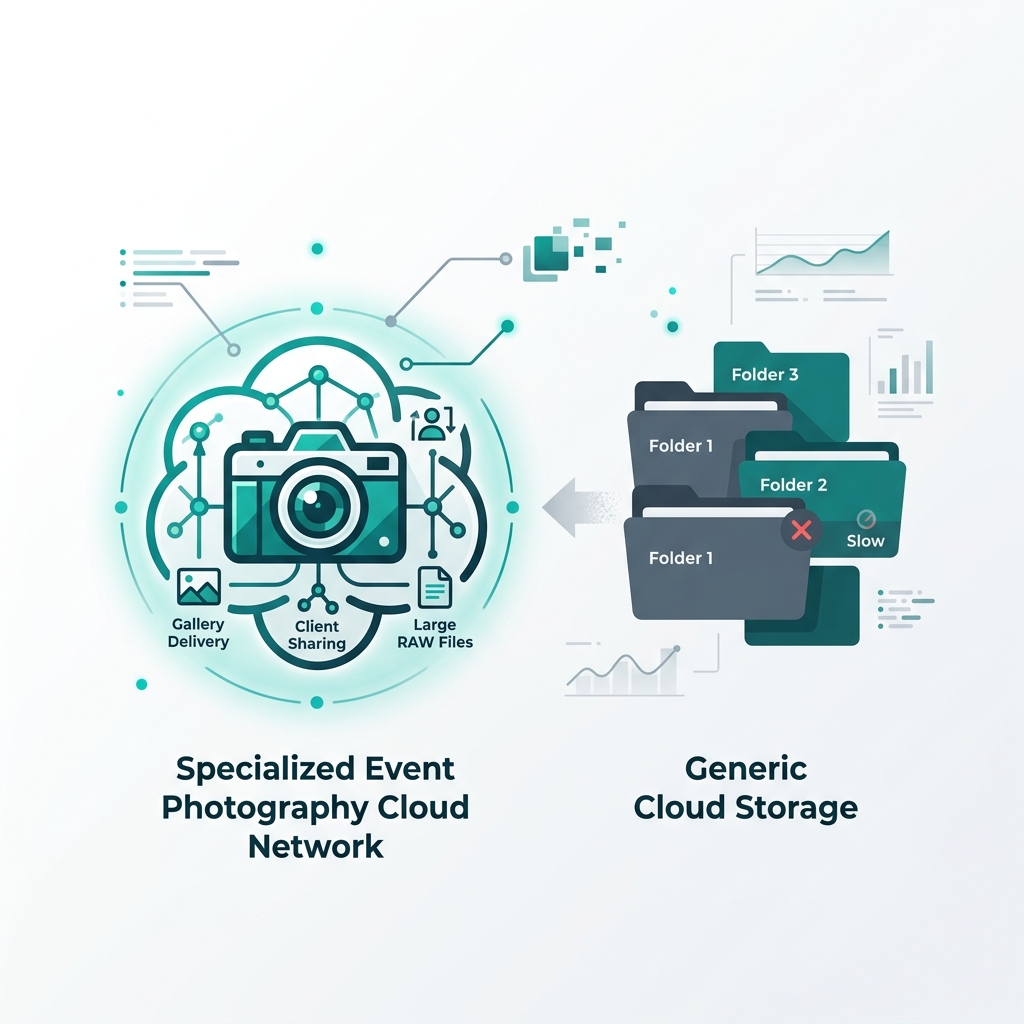
The event photography industry is undergoing a massive, unprecedented shift. We are moving away from an era where clients expected to wait four to six weeks for their wedding or corporate event photos, and hurtling toward an era defined by instant gratification. When Ayojan was first conceived, our engineering goal was simple but highly ambitious: allow an event guest to upload a selfie from their mobile phone, and within one second, instantly find every single professional photo they are in from a 10,000-image gallery.
It sounded straightforward on paper. But when we attempted to build this feature using traditional relational (SQL) and document-based (NoSQL) database architectures, the system completely collapsed under the weight of real-world scale.
In this exhaustive, highly technical detailed look, we are pulling back the curtain on our engineering journey. We will explore the mathematical realities of facial recognition, detail exactly why traditional databases failed us so catastrophically, and explain the complex architecture of vector databases that ultimately allowed us to achieve sub-50 millisecond face-search across millions of photos.
I've watched dozens of talented photographers burn out and quit the industry. Not because their photos were bad, but because they ignored this exact principle.
Setting the Stage
For photography studios and event professionals evaluating software platforms, the underlying technology matters. "AI Face Search" is a buzzword thrown around by many gallery platforms, but the infrastructure powering that search dictates whether the platform will succeed or fail during a live, 3,000-guest event.
Here are the core takeaways from our architectural overhaul:
- Facial Embeddings are Mathematically Heavy: A single face is converted into a 512-dimensional array of floating-point numbers. A standard Indian wedding generates millions of these numbers.
- SQL/NoSQL Complexity: Traditional databases rely on B-Tree indexing, which is basically incompatible with high-dimensional math. Attempting a Cosine Similarity search in PostgreSQL requires O(N) linear scans, leading to CPU throttling and 30-second query times.
- The Vector Solution: By migrating to a purpose-built vector database utilizing Hierarchical Navigable Small World (HNSW) graphs, we shifted from O(N) to O(log N) complexity.
- The Result: Search latency dropped from 30 seconds to 45 milliseconds, compute costs plummeted by 70%, and the platform achieved true horizontal scalability.
(Also, you might find our insights on this topic useful).
The Facial Recognition Pipeline Explained
To understand why databases fail, you must first understand what facial recognition actually is from a computational perspective. When a photographer uploads a JPEG to Ayojan, the AI does not look at the image the way a human does. It does not see a smile, a red dress, or a sunset. It sees a grid of pixels.
Phase 1: Face Detection
The first step is simply finding the faces. We run the image through a specialized CNN (Convolutional Neural Network), often a variant of YOLO (You Only Look Once) or MTCNN (Multi-task Cascaded Convolutional Networks), optimized specifically for human faces. This model draws bounding boxes around every face in the photo.
In a typical group shot at an Indian reception, there might be 15 to 20 faces. The model must isolate each one, ignoring the background, the lighting, and the complex traditional outfits.
Phase 2: Alignment and Cropping
Once a face is detected, it is rarely looking perfectly straight at the camera. The subject might be looking down, smiling from a side profile, or tilted. The AI must perform "Face Alignment." It locates key facial landmarks—the center of the eyes, the tip of the nose, the corners of the mouth—and applies an affine transformation to geometrically warp and crop the face into a standardized, forward-facing square template.
Phase 3: The Embedding Extraction (The Core Problem)
This is where the mathematical heavy lifting begins. The standardized face crop is fed into a deep learning recognition model, such as FaceNet, ArcFace, or a proprietary Vision Transformer.
This neural network strips away all superficial data—the lighting, the makeup, the background—and distills the structural geometry of the face into a mathematical representation known as an embedding.
In modern, high-accuracy facial recognition systems, this embedding is typically an array of 512 floating-point numbers. It looks like this in code:
[0.0453, -0.1239, 0.8871, -0.0024, 0.4412, ... (and 507 more numbers)]
Every single face in every single photo uploaded by a photographer gets converted into one of these high-dimensional vectors. If a photographer uploads a gallery of 5,000 photos, and each photo contains an average of 4 faces, our servers are instantly generating 20,000 vector arrays for a single event.
When a guest uploads a selfie, their selfie goes through this exact same pipeline, generating a single "Query Vector." To find their photos, the system must mathematically compare their 512-dimension Query Vector against the 20,000 vectors stored in the database.
The Downfall of SQL/NoSQL at Scale
When Ayojan was in its infancy, our primary data stores were PostgreSQL (for relational data like user accounts and billing) and MongoDB (for flexible document storage). It seemed logical to store the facial embeddings directly in these databases alongside the photo metadata.
The Mathematical Bottleneck of Exact Distance
To determine if two vectors represent the same person, you cannot just check if Vector A == Vector B. Lighting and angles mean the numbers will never match perfectly. Instead, you must calculate the mathematical "distance" between the two vectors in 512-dimensional space.
The two most common metrics are:
- Euclidean Distance (L2 Norm): Measures the straight-line distance between two points.
- Cosine Similarity: Measures the angle between two vectors, which is highly effective for embeddings as it ignores magnitude (e.g., overall brightness).
To find the guest's photos, our PostgreSQL database was tasked with running a Cosine Similarity calculation between the guest's Query Vector and every single one of the 20,000 vectors in the gallery.
The Linear Scan Disaster
Standard relational databases use B-Tree (Balanced Tree) or Hash indexing. These indexes are phenomenal for exact matches (e.g., SELECT * WHERE email = 'guest@example.com') or simple range queries (WHERE age > 18).
However, B-Trees are basically useless for high-dimensional spatial data. You cannot sort 512-dimensional arrays into a standard tree. Therefore, when PostgreSQL executed our facial search query, it had to perform a Full Table Scan.
It pulled row 1, performed 512 multiplications and additions, recorded the score. Pulled row 2, performed the math, recorded the score. It did this 20,000 times. Then, it sorted all 20,000 scores to find the top matches.
The Breaking Point
For a single gallery of 5,000 photos, this linear scan took about 2 to 3 seconds. In a vacuum, 3 seconds feels acceptable. But Ayojan is a multi-tenant SaaS platform.
On a Saturday night during the peak Indian wedding season (November to February), we do not have one person searching. We have hundreds of photographers uploading terabytes of data, and we have tens of thousands of wedding guests scanning QR codes and uploading selfies simultaneously.
When 500 guests execute a search query at the exact same second, the PostgreSQL server is forced to perform:
500 queries * 20,000 vectors * 512 dimensions = 5 Billion floating-point operations
Our database servers caught fire. CPU utilization spiked to 100% and stayed there. The database was entirely CPU-bound. Queries that were supposed to take 3 seconds queued up behind each other, degrading response times to 30 seconds, 60 seconds, and eventually resulting in timeout errors.
We tried vertically scaling the database (buying massive, absurdly expensive AWS RDS instances with 96 vCPUs). We tried sharding. Nothing worked. The fundamental math of O(N) complexity cannot be defeated by throwing raw compute at it.
(Want to dive deeper? Check out our guide on related workflows).
Introduction to Vector Databases & HNSW
We realized that to scale a true AI product, we could not rely on web-era databases. We needed a database engineered specifically for machine learning: a Vector Database.
Vector databases (such as Pinecone, Milvus, Qdrant, and Weaviate) are not built to store standard rows and columns. They are built entirely around storing, indexing, and querying high-dimensional arrays.
The Magic of Approximate Nearest Neighbor (ANN)
To defeat the O(N) linear scan bottleneck, vector databases abandon the concept of "Exact Match" searching. If you calculate the distance to every single vector, you are doing an Exact Nearest Neighbor (k-NN) search. It is perfectly accurate, but painfully slow.
Vector databases use Approximate Nearest Neighbor (ANN) algorithms. They accept a very small tradeoff in absolute accuracy (perhaps 99.5% accurate instead of 100%) in exchange for a massive, exponential increase in speed.
The HNSW Algorithm
The crown jewel of modern vector indexing is the Hierarchical Navigable Small World (HNSW) graph. This is the algorithm that saved Ayojan.
Instead of storing vectors in a flat table, HNSW organizes them into a multi-layered graph. Imagine a map of the world.
- The top layer of the graph only contains major continents.
- The next layer down contains countries.
- The next layer contains cities.
- The bottom layer contains every single street address.
When a guest uploads a selfie, the HNSW algorithm doesn't start checking every street address on Earth (the linear scan). It enters the graph at the top layer. It quickly sees that the vector is mathematically closer to "Asia" than "North America." It drops down to the Asia layer. It sees it is closer to "India" than "Japan." It drops down to the India layer.
By navigating this graph, the algorithm completely ignores 99% of the vectors in the database that look absolutely nothing like the guest. It only performs the heavy 512-dimension math on the tiny cluster of vectors that are highly likely to be a match.
The time complexity drops from O(N) to O(log N).
Ayojan's Specific Vector Architecture
Migrating to a vector database was a monumental engineering undertaking. We could not simply unplug PostgreSQL and plug in a vector database; we had to build a hybrid architecture that leveraged the strengths of both.
The Hybrid Data Model
Today, Ayojan operates a dual-database architecture:
- The Relational Source of Truth: We still use a solid, highly-available PostgreSQL cluster. This database stores everything that isn't a vector: user accounts, gallery names, billing history, photographer profiles, and the URL links to the high-resolution images stored in AWS S3.
- The Vector Engine: We deployed a distributed, memory-optimized vector database. This database stores only two things: the 512-dimension vector array, and a
photo_idthat maps back to PostgreSQL.
The Live Execution Flow
Here is what happens under the hood today when a guest uses Ayojan at a live event:
- The Photographer Uploads: The photographer’s editing software syncs 5,000 JPEGs to Ayojan.
- Asynchronous Processing: Ayojan’s serverless GPU workers instantly pull the images from the queue, run the face detection and extraction models, and generate the vectors.
- Dual Writing: The standard metadata (filename, timestamp, S3 URL) is written to PostgreSQL. The vectors and the
photo_idare written to the Vector Database. - The Guest Selfie: The guest scans the QR code at the event and takes a selfie. The Ayojan edge server extracts the 512-dimension Query Vector from their selfie.
- The Vector Query: The Query Vector is sent directly to the Vector Database, along with a metadata filter (
WHERE gallery_id = 'wedding-123'). - The HNSW Search: The Vector Database navigates the HNSW graph. Because it only searches within the specific gallery's namespace, the graph navigation takes less than 15 milliseconds. It returns a list of matching
photo_ids. - The Hydration: Ayojan takes those
photo_ids, performs a lightning-fastSELECT INquery on PostgreSQL to get the actual image URLs, and returns the personalized gallery to the guest's phone.
The Results of the Migration
The transition to this architecture produced metrics that essentially altered the trajectory of our business:
- Query Latency: Face-search times dropped from an unpredictable 3-15 seconds down to a flat, highly predictable 45 to 60 milliseconds.
- Scalability: The system is no longer CPU-bound. Because HNSW relies heavily on keeping the graph in RAM, we shifted to memory-optimized cloud instances. The vector database can handle thousands of concurrent queries with zero degradation in speed.
- Cost Reduction: Because we were no longer burning CPU cycles on linear scans, our compute costs dropped by nearly 70%, even as our user base tripled.
How High-Speed Delivery Translates to Financial ROI
Why does all of this deep, backend engineering matter to a wedding photographer or a corporate studio? Why should a creative professional care about HNSW graphs and O(log N) time complexity?
Because latency kills user engagement.
In the consumer tech space, there is a well-documented rule: if an app takes longer than 3 seconds to load, 50% of users will abandon it. If it takes 10 seconds, 90% of users will abandon it.
If you use a "budget" photo delivery platform that relies on outdated SQL databases for their AI search, the system will inevitably choke when you try to use it live at a 1,000-guest reception. The guests will scan the QR code, take a selfie, and stare at a spinning loading wheel for 30 seconds. They will get frustrated, put their phones in their pockets, and walk away.
The Marketing Value of Speed
When Ayojan returns a guest's photos in 45 milliseconds, it feels like magic. The speed creates a physical "wow" moment. The guest is delighted, they immediately download the photo, and they immediately post it to Instagram with your studio's watermark and tag.
Furthermore, because the system is so solid, it allows photographers to execute Live Camera-to-Cloud Workflows. If your software can index faces in real-time without crashing, you can tether your Sony or Canon camera to a 5G hotspot, FTP the JPEGs directly to Ayojan, and have guests find their photos literally minutes after you press the shutter.
This level of technological superiority is what allows Ayojan photographers to double their booking rates. You are no longer selling "photos delivered in 4 weeks." You are selling "instant, magical social media gratification." That is a premium product, and it requires a premium infrastructure.
Step-by-Step Transition Guide for Studios
If you are a studio owner realizing that your current gallery platform is technologically inadequate for the volume you shoot, transitioning to a high-performance vector-backed platform like Ayojan is critical. Here is a practical implementation guide to migrate your business without disrupting your current client pipeline.
Step 1: Audit Your Current Volume
Calculate your average event size. Do not look at the edited highlights; look at the final delivered volume. If you routinely deliver more than 1,000 photos per event, and shoot more than 20 events a year, you are operating at an enterprise scale. Standard gallery apps will throttle your uploads and crash during guest access. You are the exact demographic that requires vector infrastructure.
Step 2: The Beta Test Event
Do not transition your entire business overnight. Select an upcoming mid-sized event (e.g., a 300-guest birthday party or a small corporate luncheon).
- Create an Ayojan account and set up a branded gallery.
- After the event, upload your standard high-res JPEGs.
- Observe the indexing speed. Notice how the AI processes the faces seamlessly in the background.
Step 3: Rolling Out the QR Code Strategy
For your next large wedding, implement the live access strategy.
- Have the event planner print physical QR codes on standard A5 cardstock.
- Place them at the venue.
- When guests scan the code, watch the analytics dashboard in your Ayojan portal. You will see hundreds of unique faces being searched and matched in milliseconds.
- Monitor the lead capture. Watch as your database fills with verified emails and phone numbers from affluent guests who just experienced your magical delivery.
Step 4: Updating Your Sales Pitch
Once you have verified the speed and reliability of the platform, update your pricing PDF. Add a new premium tier that explicitly mentions "Instant AI Face-Search Delivery." Use the speed of the platform as a core differentiator against your local competitors.
FAQ Section
Q: Does storing facial vectors violate privacy laws?
A: This is a critical concern. Because Ayojan stores mathematically irreversible vectors (not the actual biometric facial image itself in the database row), it aligns with strict data protection frameworks. Furthermore, the vectors are sandboxed to the specific gallery. A vector generated at Wedding A cannot be cross-referenced or searched against Wedding B. When the gallery is deleted by the photographer, the vectors are instantly purged from the HNSW graph.
Q: Can a vector database handle blurred or poorly lit faces?
A: The Vector Database only searches the math; it relies on the Deep Learning Model (Phase 1 & 3) to generate accurate math. Our neural networks are trained on highly diverse datasets, allowing them to accurately generate stable embeddings even if the face is partially obscured, side-lit, or captured in low light. As long as the AI can extract a vector, the database will find it in milliseconds.
Q: What happens if two guests look very similar (e.g., twins)?
A: Vector databases use distance thresholds. If two vectors are extremely close in 512-dimensional space, the database returns both as high-confidence matches. In the case of identical twins, the math is nearly indistinguishable, and the system may return photos of both. However, for siblings or lookalikes, modern 512-dimension models are generally granular enough to push the vectors far enough apart to distinguish between them accurately.
Q: Why do some other platforms limit me to 2,000 photos per gallery?
A: Because they are still using SQL or NoSQL databases! They physically have to cap your gallery size because their linear scan queries will timeout if you upload 5,000 photos. When you see a platform enforcing arbitrary photo limits, it is a massive red flag regarding their backend infrastructure.
Conclusion
The evolution of event photography is inextricably linked to the evolution of data architecture. For decades, photographers were bottlenecked by physical hard drives, then by slow cloud uploads, and recently, by inadequate database structures trying to masquerade as "AI."
By abandoning the comfortable, well-understood world of relational databases and embracing the complex, mathematical frontier of vector databases and HNSW graphs, Ayojan solved the volume problem. We built a platform that does not care if you upload 500 photos or 50,000 photos. The math scales gracefully, the latency remains flat, and the end-user experience remains utterly magical.
For the modern photographer, the takeaway is clear: stop fighting your software. Align your business with enterprise-grade infrastructure, automate your distribution, and get back to doing what you actually love—capturing the moments that matter.