In the high-end event photography market, the requirements often extend beyond delivering beautiful imagery. When shooting exclusive weddings, executive summits, or private corporate retreats, privacy and discretion become paramount.
High-profile individuals and corporations operate with strict privacy expectations. Unauthorized distribution of photographs from private events or unannounced product meetings can result in significant PR issues or breaches of Non-Disclosure Agreements (NDAs).
If you attempt to deliver photos to these clients using a standard password-protected folder or an unencrypted gallery, you may be introducing unnecessary risk.
This guide explores the security protocols necessary for operating in the high-profile market. We will discuss the limitations of URL-based security, the use of biometric access controls, and how to prioritize data security in your service offerings.
The Limitations of Password Security
A common method for securing a photo gallery is to send the client a URL and a PIN code (e.g., www.yourstudio.com/VIP-Event, Password: 2024). While functional for general use, this method has limitations for high-security environments.
The Sharing Risk
Passwords are only as secure as the people who hold them. If you shoot a private corporate summit and email the password to 50 attendees, the security of the gallery is difficult to maintain. An attendee might forward the password to an assistant, who might forward it to someone outside the trusted circle.
If someone is actively looking for photos of an unannounced product, they do not need to compromise the website's infrastructure; they simply need to acquire the password from an attendee.
URL Visibility
Furthermore, the URLs themselves can be vulnerable. If a gallery platform utilizes predictable URL structures, the mere existence of the URL (e.g., /galleries/Client-Secret-Summit) might expose metadata that the client wanted hidden.
Relying entirely on a shared password for a high-security event means relying on the operational security of dozens of individuals.
(Want to dive deeper? Check out our guide on replacing physical media delivery).
Implementing Biometric Access Controls
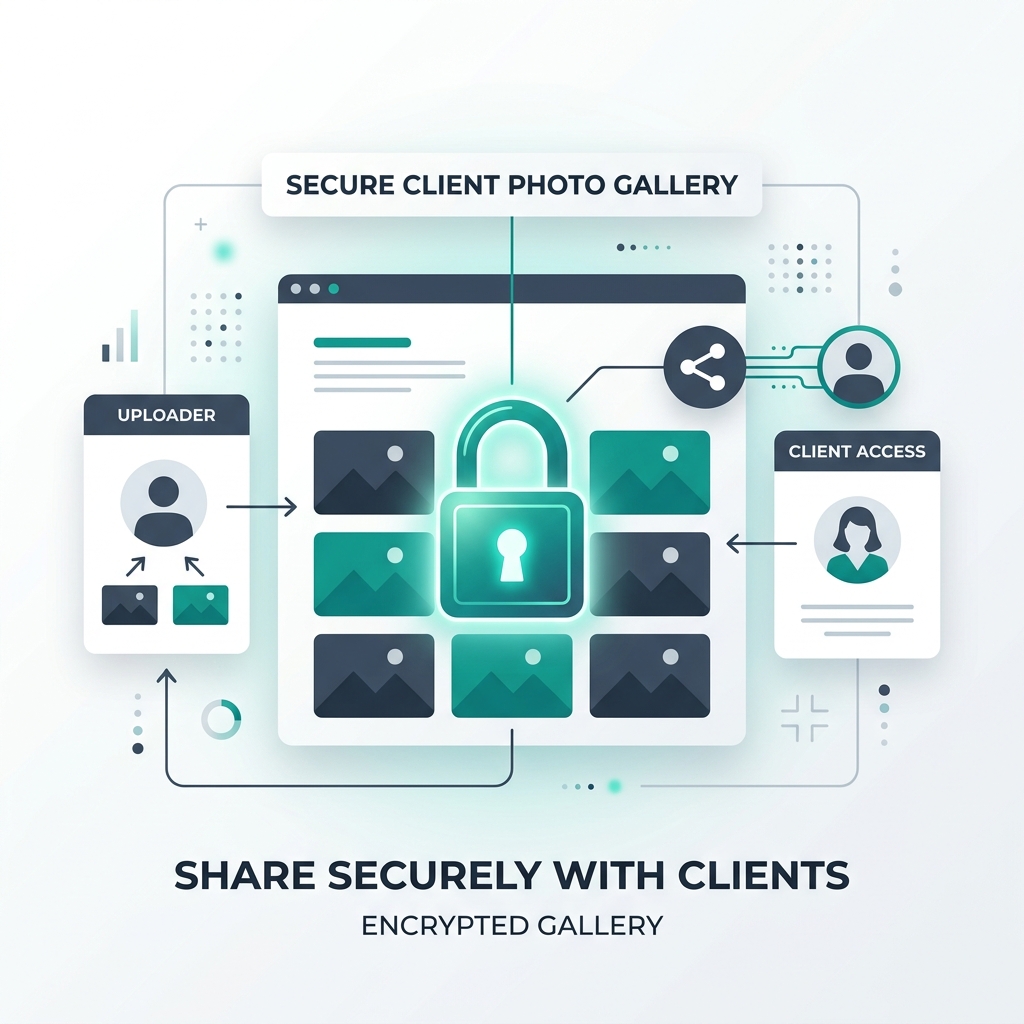
To secure data for high-profile clients effectively, you can move away from shared passwords and utilize a system where access is granted based on individual identity.
This is a core feature of the Ayojan enterprise platform.
The Secured Database
When you upload photos from a private event into Ayojan, the system does not create an openly browseable grid of thumbnails.
If an unauthorized user manages to acquire the portal link, they do not see the gallery. There is no password prompt to guess, and there is no public grid to view.
The Biometric Query
To view a photo, the user must authenticate their identity.
An attendee opens the portal and is prompted to take a live selfie. The Ayojan AI converts that selfie into a mathematical vector and queries the database using an advanced algorithm.
The attendee is presented with a personalized micro-gallery containing only the photos in which they physically appear.
Granular Data Access
This architecture mitigates the risk of shared links. If an attendee forwards the portal link to an unauthorized party, the unauthorized party takes a selfie, and the database returns zero results because their face was not captured at the event.
Furthermore, attendees cannot browse photos of other attendees. The data is siloed on an individual basis, providing a granular level of security that high-profile clients often require.
Managing Metadata (EXIF Scrubbing)
Visuals are not the only potential liability in an event photograph. The metadata embedded within the JPEG can also be sensitive.
Modern digital cameras embed EXIF (Exchangeable Image File Format) data into the file. This data includes camera settings, the exact date and time the photo was taken, and often the precise GPS coordinates of the location.
Location Privacy
If you shoot a private retreat at an undisclosed location and deliver the high-resolution JPEGs with the EXIF data intact, you may be sharing sensitive location information. If a photo is shared publicly, anyone can extract the latitude and longitude from the file's properties.
Automated Scrubbing
In a secure workflow, you should remove sensitive EXIF data before delivery.
When you utilize a platform like Ayojan, the system can be configured to scrub location and timeline metadata from the files during the ingestion process. When authorized users download a photo from the portal, they receive a clean JPEG without the secondary data, protecting the location privacy of the event.
Internal Review and Accountability
While individual attendees receive siloed access, the primary client (the corporate marketing team or the event hosts) usually requires access to the entire master gallery for review.
Secure Master Access
For the primary client, you can bypass the selfie-search by providing a complex cryptographic Master PIN. When entered into the portal, the system allows the authorized team to view the full gallery.
Accountability Watermarks
However, even within internal teams, security is important. If a team needs to download photos for internal review before public release, those photos must be handled carefully.
To assist with this, platforms can utilize Accountability Watermarks. When a specific user downloads a photo using the Master PIN, the system dynamically burns a subtle watermark across the image (e.g., “Downloaded by J.Smith@corporate.com”).
This ties the data to the specific user, which can discourage unauthorized internal sharing of sensitive media.
Communicating Security Value
In the high-profile market, technical proficiency is expected. You differentiate your services by addressing the client's privacy concerns.
When consulting with a corporate event planner or a PR team, you can emphasize your data security protocols. Explain that while standard industry practice often relies on password-protected folders, your studio utilizes a biometric access system. Detail how attendees only see their own photos, how metadata is scrubbed, and how the entire database operates securely.
By demonstrating a clear understanding of data security and offering a robust technological solution, you provide peace of mind to clients who prioritize discretion. Upgrading your delivery infrastructure to handle strict privacy requirements can make your studio a strong candidate for demanding, high-profile contracts.