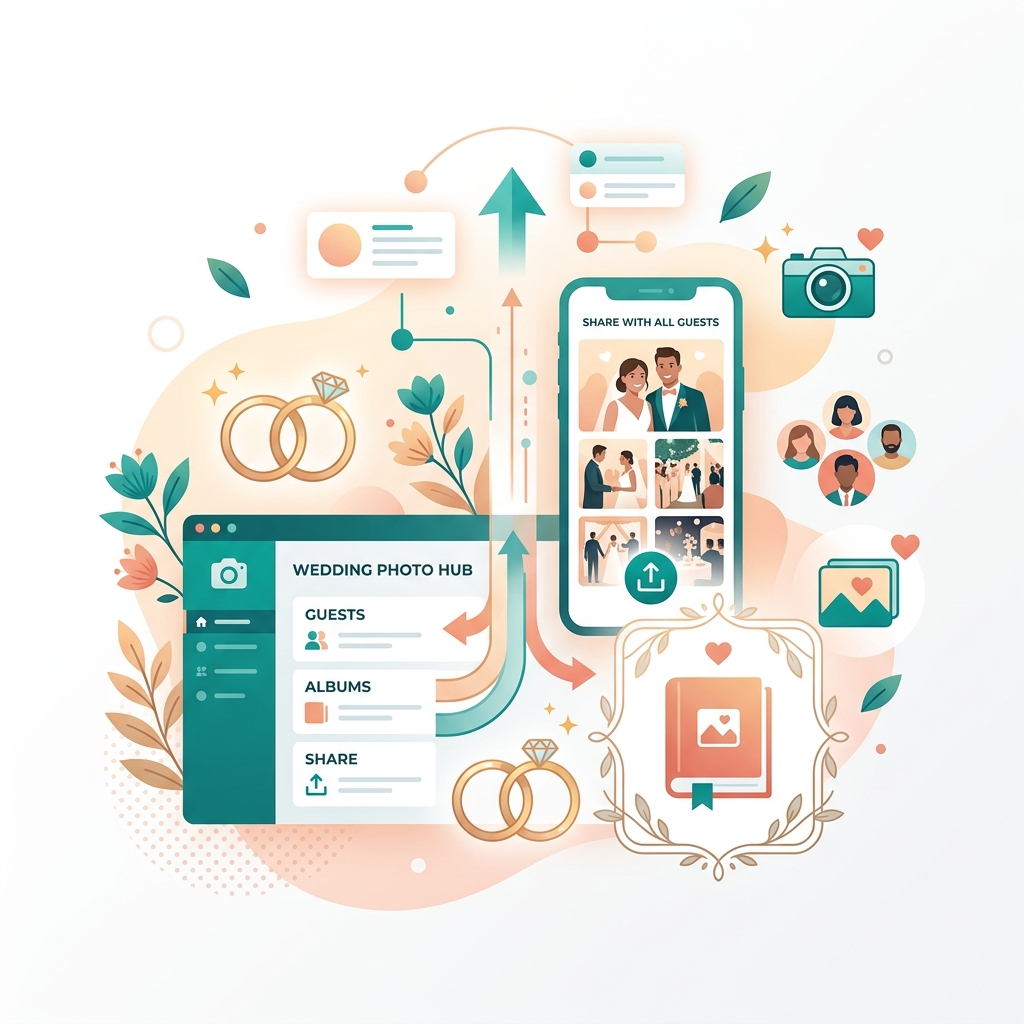
The success of a wedding photography business is often measured by the emotional reaction of the bride and groom when they first view their gallery. However, the true growth of a wedding photography business is heavily influenced by the experience of the guests who attended the wedding.
In the traditional photography model, the guests are almost entirely ignored. The photographer focuses entirely on the couple, delivers a gallery to the couple, and relies on the couple to act as the primary distribution node for the guests. This model often results in many beautiful, hard-earned images never being seen by the people in them.
To scale a premium photography studio, it helps to start treating guests as an essential part of your marketing engine. This requires reducing the friction involved in photo sharing.
This guide will explore the psychology of guest friction, the limitations of traditional sharing methods, and how implementing an AI-driven, selfie-search gallery can transform a wedding you shoot into an organic marketing event.
The Psychology of the "Friction Funnel"
To understand why guests don't share your photos, you must understand the concept of "UX Friction." In software design, friction is any obstacle—a click, a login screen, a confusing layout—that prevents a user from achieving their goal.
When a guest wants to find a photo of themselves from a wedding, their motivation can be fragile. If the process is hard, they will abandon it. Let's look at the traditional "Friction Funnel" of a standard web gallery.
Stage 1: The Discovery Friction
How does the guest even know the photos exist? Usually, the bride posts a link on her Instagram Story months after the wedding.
- Friction Point: The guest must happen to see that specific 24-hour story. If they miss it, they never know the photos are ready.
- Drop-off Rate: A large portion of guests miss this initial announcement.
Stage 2: The Access Friction
The guest clicks the link. The gallery may require an email address and a password that the bride provided in a different post.
- Friction Point: The guest has to switch apps, find the password, and type it perfectly on a mobile keyboard.
- Drop-off Rate: More users abandon the process here.
Stage 3: The Search Friction
The guest is finally in the gallery. They are confronted with thousands of photos organized into broad folders like "Ceremony" and "Reception."
- Friction Point: The guest must scroll through hundreds of thumbnails to find the candid shot of themselves dancing. After a few minutes of scrolling, they may assume they weren't photographed.
- Drop-off Rate: The final group of users often gives up here.
Out of 500 guests, maybe 25 actually find, download, and share their photos. You have spent hours editing images of the other guests, and those images will rarely be seen. This is a missed marketing opportunity.
The Selfie-Search Approach
A highly effective way to solve the Friction Funnel is to invert the search process. Instead of asking a human being to search a database of thousands of images, you ask the database to search for the human.
This is achieved through AI Facial Recognition, specifically the Selfie-Search approach deployed by platforms like Ayojan.
Zero-Friction Discovery
We reduce Discovery Friction by bringing the gallery to the guest while the event is still happening. You deploy physical QR codes on the cocktail tables. The guest does not have to wait months to see a link on social media. They see the code right in front of them during the event.
Zero-Friction Access
We reduce Access Friction by streamlining logins. The QR code links directly to the white-labeled gallery landing page on their phone.
Zero-Friction Search
This is the core feature. The landing page has one button: "Take a Selfie." The guest taps the button, the front-facing camera opens, they snap a selfie, and within milliseconds, the Ayojan vector database cross-references their face against the live gallery.
Instantly, the guest is presented with a curated grid of photos containing only their face. They didn't scroll. They didn't search manually. The software delivered the exact result they wanted.
When you provide an experience that is this seamless, the adoption rate increases significantly. You turn the guests into active, engaged consumers of your brand.
(Want to dive deeper? Check out our guide on marketing strategies for photographers).
Designing Physical Touchpoints
You cannot rely on the software alone; you must design the physical environment of the wedding to encourage guests to interact with the software. This requires coordination with the wedding planner.
The Welcome Bag Integration
At destination weddings, guests are often given a "Welcome Bag" when they check into their hotel room. You can include a physical card inside that bag. Design: A sleek, heavy-cardstock insert. Copy: "Welcome to Sarah & John's Wedding. Our professional photography team, [Your Studio], will be capturing the weekend. Scan this code at any time to instantly receive your personalized photos!"
The Table Centerpiece
The most captive audience at a wedding is a guest sitting at their table waiting for the food to arrive. Work with the florist or decorator to incorporate a small, tasteful acrylic QR code standee into the centerpieces or the menu cards. When they see the code, they will scan it out of curiosity.
The DJ Announcement
Do not be afraid to use auditory cues. Have the DJ or the MC make a short announcement right after the first dance: "Ladies and gentlemen, the photography team has set up an AI gallery for tonight! Scan the QR codes on your tables, take a selfie, and get your professional photos instantly!"
By surrounding the guest with these physical and auditory touchpoints, you ensure that interacting with your delivery platform becomes a seamless part of the event.
Capitalizing on the Viral Output
The goal of reducing friction is to encourage Social Media Sharing.
When a guest finds their stunning, professionally lit photo quickly, they want to share it. You must ensure that when they share it, your studio captures the value of that share.
The Watermark Requirement
Every photo a guest downloads from the AI gallery should feature a tasteful, semi-transparent watermark of your studio's logo in the corner. Make it legible but unobtrusive. When the guest posts that photo to their Instagram grid, your logo acts as a marker for your brand.
The Metadata and Pre-Written Caption
When the guest taps the "Share to Instagram Story" button within the Ayojan web app, the app can pass specific data to the social platform. Instead of the guest just posting a blank photo, the system can pre-populate the screen with the official wedding hashtag and explicitly tag your studio's handle.
When you make it effortless for the guest to tag you, they are much more likely to do it.
The Inbound Leads
Let’s look at the potential output:
- You shoot a wedding with 500 guests.
- Because of your QR codes, 400 guests use the selfie search.
- 200 guests post a photo to their Instagram Story that night.
- Each guest has an average of 800 followers.
- Your watermarked, tagged photo is viewed by a large audience within 24 hours.
Among those viewers, there are likely engaged couples who are currently looking for a wedding photographer. They see the stunning photo of their friend, they see your tag, they click your profile, and they book you.
Protecting the Bride's Privacy
When you implement a system that makes it easy for guests to access photos, you may have a bride ask: "Does this mean any guest can see all of my private getting-ready photos?"
This is a common question, and you must address it clearly.
The AI Firewall
You explain to the bride that the AI system actually provides more privacy than a traditional open cloud link.
"Because the system uses facial recognition to unlock the photos, a guest can ONLY see photos that their face is physically in. If an extended relative scans the code, they will only see photos of themselves at the reception. They cannot see your private bridal suite photos, your first look, or your couples portraits, because their face is not in them. The AI ensures that every guest only sees their own photos, while you and your partner have a secure master password to see the entire gallery."
When the bride understands that the AI protects her intimate moments, she will view the technology as a premium benefit.
Moving Forward
The wedding photography industry is expanding its focus to include the entire network of guests. You are no longer just delivering a product to the bride; you are distributing media to a highly connected network of individuals.
If you continue to use high-friction, password-protected folder structures, you may be limiting your own marketing channel.
By upgrading to an AI-driven, selfie-search platform like Ayojan, you remove the friction. You turn a tedious administrative chore into an interactive live experience. You delight the guests, you protect the bride's privacy, and you increase the chances that your studio's imagery reaches your target demographic. This is a highly effective approach for the modern wedding photographer.